May 4, 2005: 12:15 am: Uncategorized

Do you know this man?

Odds are, you don’t, but you probably agree with him about one thing:

“Imitation is the sincerest form of television.”

The man is Fred Allen, and he was a huge force in entertainment back in the 1940s. you probably know some of his work. Or at least a reasonable facsimile.

How about this guy, over here? That’s Foghorn Leghorn. “Now wha, I say what’s the big idea!”

Foghorn Leghorn was a direct ripoff of a Fred Allen’s recurring character, Senator Claghorn. “Now, who’s responsible for this attack on my person?

The point here is that even Fred Allen, at the top of his game, knew that television was two things: cyclical and cynical. “Any of this getting through to ya son?”

Most of the time, television has stayed true to its disposable nature, to the extent that when a show lasts longer than 100 episodes it’s considered a raging success. We know that all good things, in order to be good, are temporary… and will end.

This is the dilemma facing the Miss America pageant. It’s been a staple for so long, it’s a part of the culture. Few television relics survived multiple generations: Bob Hope, the Tonight Show, and Miss America.

Ratings have been steadily declining, and since ABC has dropped the television rights, the producers are scrambling to find a better way to pitch (and promise) profitability. And it sounds like they are about to prove Fred Allen right:

“The Miss America Organization has hired the William Morris Agency to shop a pageant telecast reworked as a reality show, with competition stretched over several episodes, backstage access, and possibly even an open vote for the winner.”

In a business where your image is everything, what do you do when your image no longer sells? Products are reworked all the time, but Miss America isn’t a widget in need of better wrapping. It “is” the wrapping.

Let’s see what the brain trust comes up with here. Maybe it’ll go all “Survivor” on us. Maybe more “Fear Factor.” Or maybe they just need to listen to Foghorn Leghorn, and spice up the evening gown competition with a strip show: “Show ‘em what ya got but dooon’t let ‘em have it. Ya gotta teeeze ‘em a little. Make ‘em chase ya.”

(Big credit to Neal Abrams for hosting a bunch of great sound clips.)

April 25, 2005: 3:39 pm: Uncategorized

Forget about Overstock.com being the “Big O”… Opera is making waves in the Atlantic. Literally.

If you aren’t familiar with Opera, it’s an alternative web browser that’s been around longer than Firefox. It’s quite fast, although the only free version does feature advertising. (Still not obtrusive, though.)

Opera recently released Version 8.0 for download, and with the sudden burst of recent activity for Mozilla’s Firefox browser, Opera CEO Jon von Tetzchner made a bold (cold) promise: If Opera-8 gets 1-million downloads in the first four days of release, he’d swim from Norway to the United States.

Oops. Now, he’s all wet. As in already in the water on the way to America.

“Although I blatantly admit that my promise was based more on joy and enthusiasm than my swimming abilities and physical health, I will do my very best to keep it,” he said in a statement.

He’s not totally insane, though. First of all, he’s taking his PR guy with him. Spokesman Eskil Sivertsen is rowing a boat alongside (presumably as punishment for releasing the braggadocious statement to begin with.) Sivertsen is bringing along a satellite phone, maps, food, water and a book with inspirational quotes from the Viking sagas.

“It’s the least he can do, having put me in this situation in the first place,” says Jon S. von Tetzchner with a wicked grin on his face. “Besides, I can’t swim to the USA without maps, and this wet suit doesn’t seem to have any pockets, so it’s good to have him there – also as someone to talk to along the way.”

The photo ops alone make this a winner. Opera gets tons of free publicity, the image of a corporate leader who stands by his word, and the “ocean voyage to America” theme harkens back to conquest — which is a good place to position your third-place browser with less than 1-percent market share.

(PS: If you want to try Opera, don’t worry about the “AdWare” designation. It loads the ads as you surf, and the ads stay in the same banner near the browser buttons. It doesn’t load additional sneaky software onto your machine.)

Update: “Brave CEO saves PR Manager in Dramatic Rescue at Sea.” Just brilliant.

April 20, 2005: 4:25 pm: Retail Detail

We’ve documented the ins and outs of Wal-Mart’s shift in public relations strategy.
(That is, a shift from nothing to something.)

Since PR and marketing tend to be bigger losers when the economy and budgets tighten, we now have a classic laboratory case for just how much ‘media savvy’ is truly worth.

MSN Money asks the question, Can Wal-Mart’s PR campaign save its stock?

Also — with Wal-Mart now answering the challenge of its critics, will some of the heat transfer to other retailers?

CNN/Money looks at what could be the end of the free ride for Target.

April 6, 2005: 10:14 pm: Uncategorized

It wasn’t hard to see this train coming. The flap between the University of Alabama and sports artist Daniel Moore isn’t exactly going UA’s way. Even if they win the case, they lose from a public relations standpoint.

The feedback is overwhelmingly in Moore’s favor, with a few people chiming in on UA’s behalf. Sportswriters are treating the “Crimson A” like a new Scarlet Letter.

All of this apparently hit the newsstands about the time the new Alabama Alumni magazine hit mailboxes. And who did the Jesters of Irony place on the cover?


Now comes the latest salvo: Moore’s refusal to pay royalties is costing students their scholarships. (Will that message really play with a hardcore fanatic audience that allegedly doesn’t care about graduation rates and academics?)

April 5, 2005: 5:32 pm: Retail Detail

When you’re as big as Wal-Mart, and you’ve been this silent for so long, the fact that you are talking is enough to make news.

The mega-mega-retailer is hosting a two-day media blitz in Bentonville, no doubt to start bending editorial ears to their spin on various issues.

For the longest time, Wal-Mart was able to enjoy the 8,000-pound gorilla position, and didn’t have to address critics. The corporate growth curve was still sharp and steep, and if it ain’t broke…

…we’ll know in the next few days about how well Wal-Mart’s spin legions are able to handle the pre-emptive counterstrikes. Labor organizations are feeding the media frenzy in the final hours, hoping to shape the debate.

This can be an effective tactic, when you know a competitor or adversary is on the brink of unveiling a new effort or campaign. At the very least, it projects your position as that of equal footing, and gives you at least a chance to frame the issues from your perspective.

Given the number of contentious issues that has hounded Wal-Mart in recent years (lawsuits over gender equity and the use of illegal aliens, predatory pricing practices, contracting out of the US…) this is probably a wise move. Any extra time Wal-Mart spends dealing with “labor-prepped” media will likely translate into extra ink. Even if the issue winds up being a wash, you’re still getting free publicity for your cause, and even re-energizing your own base.

What you do give up, though, is the chance to get the last word. Wal-Mart will likely counter with a series of talking points, and given the fact they’ve had years to work on them, they’ll probably be pretty good ones. That’s a trade-off you have to consider when you time your releases and points to meet the other guy’s calendar.

March 31, 2005: 4:57 pm: Uncategorized

Even the mighty need a little love…

Wal-Mart is holding a media conference — not about a particular subject or incident. Just ’cause.

The retailer has taken a number of hits in the media over the years, but has always taken the philosophy that as long as we’re growing, why risk it? Well — here’s why:

“Despite Wal-Mart’s negative image, throngs of customers keep shopping at its stores, but that could change, image experts said.

‘Any retailer has to be cautious about consumers’ opinions of their business ethics and practices,’ said Howard Rubenstein, president of Rubenstein Associates, a New York-based public relations firm.”

The 50 or so journalists who are expected to make the trip to Arkansas to attend will have plenty of past fodder on which to chew… and Wal-Mart can ill afford to play around with the responses.

“They need to persuade people they are bigger than people’s attitudes toward them,” said Clarke Caywood, professor of public relations at Northwestern University in Evanston, Ill.

My guess is the Bentonville marketing machine knows how to use Google News, and they are well aware of what will be asked. There could even be an advantage in being able to prepare for everything, because the press will have to as well. But a hungry press could stir a frenzy now that there’s blood in the water.

“This is clearly by Wal-Mart’s own admission a damage control tour,” said Christy Setzer, a spokeswoman at the AFL-CIO, whose United Food and Commercial Workers Union is trying to organize workers at some Wal-Mart stores. “They are aware of a growing chorus of community leaders, environmentalists and religious leaders, who are saying that Wal-Mart’s values are not our values. And they need to respond to this. It is telling that they would rather spend millions of dollars on PR efforts than to change their business practices.

The irony here is that the company does have some decent things going on within its various communities, in terms of charitable involvement and corporate citizenry. But there hasn’t been a comprehensive strategy to capitalize on that as an antidote to the anti-Wal-mart sentiment.

If I can find a transcript of the newser, it might be fun to pick apart the answers.

Anyone interested?

March 24, 2005: 12:17 pm: Uncategorized

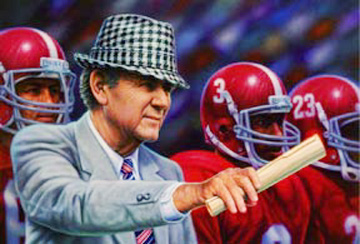
If you don’t recognize the guy at the left, don’t worry. You probably recognize his work.

Daniel Moore is the 2005 Sports Artist of the Year, although in the state of Alabama, he’s really been the only sports artist of record for an entire generation.

Remember that postage stamp honoring Coach Paul “Bear” Bryant? Moore did that one. He also did the stamps for Pop Warner, George Halas and Vince Lombardi. He’s more well-known for photo-realistic depictions of turning points from crucial games. You can see them in athletic departments, and in the dens and offices of rich (and not-so-rich) fans and boosters across the Southeast.

Anyway… now he’s being sued by the University of Alabama in a licensing dispute.

The university’s lawsuit, which Moore said he received via fax on Friday, claims Moore has violated trademark law and marketed some products with Crimson Tide images without paying licensing fees.

It seems the University isn’t going after Moore to be vindictive — it’s a matter of not establishing a precedent by letting people walk all over their trademarks. But Moore’s attorneys say a 2000 case involving Tiger Woods set the legal standard that art is free speech, and is not subject to license fees based on content.

I don’t know the ins and outs of the legal briefs, but I do know this: the university isn’t winning the PR war.

In his own news release, Moore states:

“Dr. (Finus) Gaston conveyed the University’s position as being that a mere depiction of an Alabama sports uniform in a Fine Art Print is cause enough for the work to be subject to licensing—even if it did not include a depiction of a registered trademark of the school itself. “

Wow. That seems rather greedy, and according to an online poll by AL.com, 85% of the respondents voted no on the question “Should Daniel Moore have to pay licensing fees to the University of Alabama?”

I know the University took a long time to eventually file an action. But it does make you wonder whether the guardians of the school’s images won out over the guardians of the school’s reputation. Even if UA wins… it loses.

March 23, 2005: 4:36 pm: Uncategorized

(zoom zoom.)
Zoom – zoom – zoom…

A Wisconsin woman tries to invoke the lemon law, and Mazda kicks and screams through the appellate courts.

I don’t know who to blame more — the lawyers who are dragging this thing on, or the PR people who aren’t pointing out the inherent danger of seeking bad publicity.

March 16, 2005: 4:34 pm: Uncategorized

Folks… it’s been feast or famine in the Good-and-the-Bad. Other than the ongoing Michael Jackson media circus, the wilderness is silent. (And speaking of the circus — I’ve desperately avoided mentioning that Jackson’s handlers are cutting off his nose to spite his… nah. Too easy.)

So — I bring you a couple of original thoughts, and how you need to avoid them in your implementation.

First, what I call The Beekeeping Theory of Public Relations: Blow a lot of smoke, and hope it keeps you from getting stung.

This is more common than you would think, and it’s more a result of a lack of planning. Sometimes, it’s employed by organizations that are trying to slip their bad medicine out in giant sugar-coated containers — hoping the sheer volume of released information will make it less likely to be discovered. Risky, at best.

The second notion is what I call the Nostril Theory: PR strategies are like nostrils… everybody has two, and picking one in public will tarnish your reputation.

Flip-flopping was the buzzword of the last political season, and it has enough legs that it can apply to you. All you have to do is be caught in an apparent contradiction during a crisis. It’s that simple.

There really is more than one possible course of action for every conceivable corporate disaster. Just don’t get caught trying to switch mid-stream. Commit to your plan, and stay the course. Those who stray are either not paying attention, or do so because they see what they perceive as an opportunity to take advantage of a short-term situation. Whether it’s a competitor’s failure, or a sympathetic ear in the media — you have to make sure you stick to the plan. Others are counting on you to maintain the same consitent message and tone.

Just a couple of thoughts to brighten your day.

March 2, 2005: 3:25 pm: Uncategorized

Here‘s a story about a PR expert who got bounced out of Neverland.

Apparently, she had some ideas about how the King of Pop ought defend his image, but never got to the throne room. Instead, someone on the inside hatched a plan to play hardball with the eventual complaintant.

Ann Kite, who also goes by the professional name Ann Gabriel, told jurors in Jackson’s trial that she was hired by his Las Vegas-based lawyer, David LeGrand, less than a week after the documentary, “Living With Michael Jackson,” aired on Britain’s ITV on February 3, 2003.

A different version, based on the same material, later aired in the United States on ABC.

Kite described the program as “an absolute disaster” for the pop star and that, on a damage scale from one to 10, she would put it at “a 25.”

Well — that sounds about right to me.

In his cross-examination, defense attorney Thomas Mesereau Jr. challenged Kite’s description of herself as a crisis management expert, getting her to admit that the only other celebrity client she had was an obscure Las Vegas entertainer whose act included self-hypnosis.

“You really weren’t very experienced in the area of celebrity crisis management,” Mesereau said, asking Kite why she described herself that way.

“I’ve seen a lot,” she replied.

Mesereau is trying to discredit Kite, because prosecutors are using her to prove that the original Martin Bashir documentary backfired on the singer. She claims that her dismissal came directly on the heels of information that Jackson’s handlers thought would paint the accuser’s mother as a “crack whore.”

Some people just don’t get it.

A good crisis manager is someone who can deliver a good read on outside opinion. Don’t shoot the messenger.

February 17, 2005: 4:00 pm: Uncategorized

Okay, I am not advocating that you get right out there and go to Political Pundit School, but there’s is a key point or two in this article that make sense.

Media training isn’t new, and even though the arenas may change, the fundamental prinicples still apply: When it is your name and reputation on the line, you need to be clear and concise in your messaging.

This author is recounting his trip to a hardcore boot-camp for television talking heads. Much of the advice runs counter to what we generally recommend… but then again, most of our training clients aren’t working in a place where you have to shout to be heard, and confrontation rules the day.

The one skill that does pertain is how to incorporate your key messages into a conversation:

“I ran out of things to say. This is a problem that plagues inexperienced pundits, but Masters has an easy solution: come up with a list of talking points and commit them to memory. ‘To train yourself,’ he went on, ‘be prepared to weave your points into any conversation. It’s a fun thing to practice at cocktail parties.’”


This can be a difficult skill to acquire, because there are so many precursor skills to learn and few people teaching those basics.

I like to think of this challenge according to the “hooks” of the subject.

Listen for a commonality with the subject of your key message.
Listen for a commonality with the action you are proscribing.
Listen for a commonality with the object of the action.

Subject. Verb. Object.

Someway, somehow, you can usually tie one of your points to someone else’s comments. It may require some adjustments, either in impact or in scale:

“Masters counsels clients to either broaden the question or narrow it, depending on what suits their partisan purposes. Was Bush helped by strong job numbers this month? Then the broader issue is the continual outsourcing of American jobs. Are Hillary’s favorability ratings on the rise? No problem: in red states she still ranks below avian flu.”

Finally, there is the issue of getting the most out of the message you have constructed. Master storyteller Wayne Freedman often coaches the power in the “Rule of 3s,” and educators have long taught in three-steps: instruction, application, and correction. “Three”s are so natural to us, we tend to hear them or look for them even when they aren’t there. (I know there’s someone in your office that always asks ‘Who’s next?‘ after two prominent celebrities die.) Use that to your advantage:

“People think and process information in groups of three,” he explained. “Larry, Curly, Moe. Beginning, middle, end. Anytime you answer a question, first hit your message, then enhance it with a story or an anecdote, then hit it again. Narrow, wide, narrow.”

February 11, 2005: 3:45 pm: Uncategorized

For those of you outside of the area, the Greater Alabama Council of the Boy Scouts of America is being investigated by the FBI. It is charged with inflating its membership rolls.

Of particular interest is the fact that these charges have been public for a number of weeks now, and the scouts finally got around to hiring an outside public relations firm to assist with messaging. Here’s what got my attention:

The council, which confirmed the FBI review last month and said it was cooperating with investigators, said it had developed “an aggressive plan” for implementing an internal audit.

That’s it? After all of that time, all we get is an “aggressive plan” for implementing an “internal audit?”

Folks… this is a clear case of an organization needing a crisis communications plan. Once there is a situation that threatens your institutional credibility, you need to get out front with a statement like this one. I like the word selection: aggressive, internal, and audit are all strong words that invoke connotations of swift and sure action. They promote confidence.

They also fly in the face of reality if they are used nearly four weeks after their peak effectiveness.

You mean to tell me that only now, weeks after the feds have raided your place and rolled out files in front of television cameras… only now are you developing a plan for an internal audit?

Many days late — and considering what they are paying their outside spokespeople — many dollars short.

A business or team with a halfway decent proactive crisis communications plan could have put that out within 30 minutes.

February 7, 2005: 11:14 pm: Uncategorized

…And this example is all about mixing your messages (or being caught while trying to obscure something.)

Aesthetically, I really liked the DirecTv ad with the kid who ages as he walks from room to room. The seams were well-masked, using a combination of new technology and old techniques (see Hitchcock’s “The Rope.”)

The payoff at the end, which admittedly was not as memorable as the meat of the ad, was a pitch for DirecTv’s new Hi-Def initiatives. The tagline was “Rethink TV.”

That’s all well and good — until my DirecTv bill showed up in the mail. Along with the notice that our service package price was going up in March.

Maybe — just maybe — the middle of an across-the-board rate increase is *NOT* the time to encourage customers to “rethink TV.”

Rule of thumb: make sure your key messages aren’t internally inconsistent with your actions. Or as Confucious put it, “words and deeds must be in harmony.”

: 12:59 am: Uncategorized

What can I say. I am a sucker for truth.

And the FedEx/Kinkos ad hit it squarely on the head, with a rundown of cliches necessary for SuperBowl Ad success:
1) Celebrity
2) Animal
3) Dancing animal
4) Cute kid
5) Groin kick
6) Talking animal
7) Attractive females
8) Product pitch (optional)
9) Catchy pop song
10) Bonus ending

I typed this from memory, AND I remembered which company placed the ad. That means it was effective, at least in the sense that a great number of past ads were so funny you forgot the product they were sponsoring.

February 1, 2005: 4:36 pm: Uncategorized

A Denver-based outfit is now offering preventative advice to athletes that are on the way up. As you can guess, the media training is going to rely heavily on sports analogies:

“Media Training Camp helps athletes assess the media “playing field”, develop and deliver messages that resonate with fans and analyze the effectiveness of their efforts. Participants will learn how to “score points”, “avoid penalties” and know when to play offense or defense with the media.”

I guess the real question here is who is going to get to these kids in college while they are still making their reputations and before they have the money to afford media training? A lot of big-time university programs would be well-served to find a way to bring media advice to these kids early.

« Previous PageNext Page »