June 13, 2005: 4:21 pm: IkeUncategorized
Well, we know who speaks for MJ.
The jury.
 Stuff like this needs to be moderated.
Seriously — where are the keyword filters to ensure this kind of thing doesn’t cause a PR headache?
Or, for the highly cynical… how many people think someone at Kraft dreamed this up as a way to generate web traffic through viral marketing?
Have a safe weekend everyone… especially those in the South, about to get another good drenching.
 “The number of days it took Wal-Mart to botch its new proactive public relations strategy.”
“What is Thirty-three.”
“Correct.”
“I’ll take “Self-inflicted Public Relations Nightmares” for $800, Alex.”
You don’t have to be a Ken Jennings know-it-all to recognize a bad idea.
After waking from decades of PR hibernation, it took Wal-Mart less than five weeks to stumble across a PR disaster. (At least one of its own making.)
A Wal-Mart PR manager has now resigned, after taking out a controversial ad in an Arizona newspaper. It was part of an informational campaign to answer opponents a Flagstaff Wal-Mart expansion.
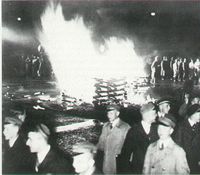 The ad attempted to draw a parallel between book burnings and the prevention of free commerce. The accompanying text read:
“Should we let government tell us what we can read? Of course not . . . So why should we allow local government to limit where we shop?”
That’s a fairly complicated message to attempt given the short-attention span of our culture. The problem is that no one realized the picture was from a Nazi book-burning. No one, except the Arizona Anti-Defamation League.
Not only has the executive responsible resigned, but the firm that produced the ad severed its retainer with Wal-Mart.
Here is a link to a .pdf of the actual ad.
This is especially foul because Wal-Mart turned a corner in both proactive and reactive PR messaging, holding a press junket on April 5th of this year. It didn’t take long for the rookie mistake to emerge.
(By the way… Wal-Mart spent nearly $300,000 on that Flagstaff campaign, just to add a grocery section to one of its stores. Apparently, they spent just enough. The ordinance limiting Wal-Mart’s expansion was overturned by two percentage points.)
You’ve got to spend a few billion…
…to make a few trillion.
Just a quick link to projections about how businesses are trending on spending.
“Web development, combined with public relations, will capture $100 billion of the one trillion dollars earmarked for marketing expenditures in 2005, according to research firm Blackfriars Communications. The company’s new report evaluates marketing budgets by industry.”
Interesting that PR and “web development” are intertwined in that report. Could it be because there will be a lot of overlap in those categories? There sure are more and more job opportunities for corporate bloggers.
Television stations love to hype their weather coverage. Nothing says “promo” like viewers who say “Channel ## saved my life!”
In my years of tornado chasing, I had more than a few people who noticed the irony, that while my station’s weather department was telling people to take cover, my news department was plotting my intercept course with the funnel.
 Well, a similar type of incongruence has led to a public squabble in Tampa. WFLA News Director Forrest Carr is now the ex-News Director, and he says it’s because there was no station hurricane plan.
 Carr claims he got frustrated with General Manager Eric Land, because WFLA had no back-up plan and no evacuation plan for the next hurricane that threatened. Carr says he was canned after asking if this was a violation of evacuation laws, which Land perceived as a threat.
Of course, Land claims this is a personnel issue, and he can’t comment on it. Sure makes him look bad, along with owner Media General. (So much for “on my side.”)
 Still, there is a narrow window of opportunity here for the station to do a little good PR. A lot of public information, followed by a recounting of WFLA’s own plan will do wonders.
After all… you’d hate to see in interview after the next hurricane with someone in a body cast, who says “If Channel 8 wasn’t taking it seriously, why should I?”
Brad and Angelina don’t want to talk about their relationship while out promoting their new movie. Instead of politely declining to answer questions, they use legal muscle. You can’t even get into the room to ask a question unless you sign a document promising to only ask about their movie. (Unless you want to talk about their globe-hopping charity and politics.)
The “contract” goes so far as to promise legal action if any of the interviews are used in an unflattering manner.
I guess it’s hard to promote “Mr. and Mrs. Smith” with words like “homewrecker” being bandied about.
 It’s interesting to see how the slowly brewing Boy Scout recruitment story gets played out in local territories across the nation.
As we have talked about before, scout regions in Birmingham and Atlanta have been under federal investigation for inflating the numbers of minority members. (There was a special grant for recruitment in the inner cities.)
While the news out of Atlanta doesn’t look good, different areas are taking divergent tacks in their spin. For instance, scout leaders in Washington, DC are denying there’s a widespread problem. A spokesman in New Hampshire is telling local media they are conducting an independent audit to determine if there is a discrepancy.
You could make arguments either way. The DC posture is one of assurance that there is no local wrongdoing. The NH position seems wishy-washy on the surface (“We don’t know if we’re in compliance,”) but actually follows through with a demonstrable action. In the end, the NH strategy comes off a bit stronger, in my humble opinion. There’s also a chance that the DC statement will boomerang and haunt the leadership, should any type of financial question arise.
One is the bolder statement today. The other is the safer tomorrow. In your own dealings, choose the time frame that best fits your strategic goals and needs.
Most public relations problems are the result of a mistake or a miscommunication.
Every so often, you run across an example of a blunder that makes you wonder: “What were you thinking???”
 A middle school principal in Georgia is playing damage control, after denying a visit from a U.S. Marine who wanted to thank a class who wrote him while he was overseas.
So far, her backtracking and explanations have not been consistent, and she’s digging herself into a bigger hole.
…unless you’re the 900-pound gorilla.
 The Wal-Mart bashers are out in force, and this time they are crying foul that the retailer would dare stoop to spending big bucks on “reputation management.” (After all, they ought to be using that cash to give employees better benefits, and raises so they can afford to shop at Target.)
I’m not the only one who’s been watching the awakening of the giant. Peter Himler has his take on a burgeoning double-standard in his “The Flack” blog.
 Good PR isn’t an accident: it’s a matter of finding the right people to carry your best message to an audience that needs to hear it.
As much as we tout PR as an essential element of any campaign, there are times when the “silent support” can bite you in the hiney.
Take the situation brewing in Jefferson County, Alabama.
The county is already under fire for runaway sewer rates and unnecessary upgrades, and several members of the sewer department are under federal indictment for kickbacks. That’s the climate you need to understand the following:
A year ago, after a number of public miscues (and before the fraud charges) the county decided to contract with PR firms to help with messaging and strategy. Among other things, the firms are creating a media database, logging media hits, and publishing newsletters for neighborhoods.
Except now we find out those same firms may have been used to promote a referendum on a 1-cent sales tax increase — and paid with public funds to do so.
Oops.
The county is in a real pickle, because there is a paper trail showing that the PR firms had started work on the project before any votes to proceed, and before the notion had gone public.
Oops oops.
Part two runs in Wednesday’ Birmingham Post-Herald — and I’ll keep plumbing this story for object lessons. (Such as, there are times as a PR practitioner that you need to recognize the potential for conflict of interest, and know that your mere presence could be a liability.)
Update: Part two of the series.
If rules govern the game, then meta-rules govern the rules.
If definitions describe words, then meta-definitions define definitions.
So what is “meta-publicity?” It’s any publicity one accrues not from the act of directly seeking publicity, but instead from merely starting to organize a campaign. This isn’t that alien a concept. Think of the headlines a politician gets from establishing an “exploratory committee.” Or even headlines about how much money has been raised/allocated to sway votes or public opinion or consumers.
There’s a bit of gamesmanship in trying to ride meta-publicity for maximum effect. There’s even a big risk in the political arena, where allowing your opponents to disparage your efforts can be as bad as tipping your hand too early.
I got to thinking about this as I stumbled upon the most brazen and well-executed case of meta-publicity I’ve ever seen: A Main Street music festival in Rogers, Arkansas, got a big write-up in the local paper… for getting its first-ever Public Relations Intern.
“This is not running errands and getting coffee,” Wolf said of the new intern’s position.
Most interns feel great about writing a press release or two — this guy got placement before he even officially joined the team! Talk about results!
Working on the public relations needs for this year’s festival is exciting, Conley said, but added that he’s also receiving a couple of credit hours for the internship. He’s a public relations major who will be a senior this fall.“This is the kind of environment I want to work in,” Conley said.
Working in public relations for a worthwhile nonprofit organization, such as Main Street Rogers, can be particularly fulfilling, he said.Conley just went to work this week, but Wolf said she’s already had him design an advertisement thanking supporters of Main Street’s golf tournament earlier this month. He’s also starting to work on advertisements for the festival, she said.
Yeah — this all sounds really silly. “Small-town rubes with nothing better to put in the newspaper.”
 Truth be told, it’s really no sillier than all of the mainstream media fawning over anything with the word “blog” in it. (There is nothing magical about the word — which really isn’t a word at all, but instead is a headless portmanteau.) Blogs aren’t a panacea, and they aren’t the best thing since pre-fab de-crusted peanut-butter sandwiches for the lazy picky eater.
Blogs are a tool. And nothing more.
Although a lot of people are going to get burned by trying to “allocate resource matrices” and “leverage communications synergies” by adding a damned blog to the company site. Blogs are a great way of being heard and getting feedback, but you have to have something to say.
Don’t get sucked into the meta-publicity of blogging. The fact that your company is starting one up won’t be newsworthy for long. Unless you post some crazy things that get you the wrong flavor of publicity.
 Speaking of flavor — I’m hungry for a pre-fab de-crusted peanut-butter sandwich. I simply don’t have the time or patience to trim away all that crust. And don’t get me started on the crust — that’s the first part of the bread to mold. Nothing but the tasty middle of the bread for me, Jack. And my sandwiches are so fresh when I want them, thanks to this cool new Uncrustable’s Sandwich Keeper. (Which is an awful lot like most blogs. Pretty on the outside — seemingly perfect for the job — yet either empty, or filled with something that at best you don’t need, or at worst might harm you.)
Edit: Well, what do you know? This item from USA Today slipped right under my radar. Seems I am not alone.
Newsweek’s got a bigger problem.
Just when it appeared Newsweek might be getting past the fallout from the backtrack on the Koran abuse story — The Washington Post Company has a more difficult situation to handle.
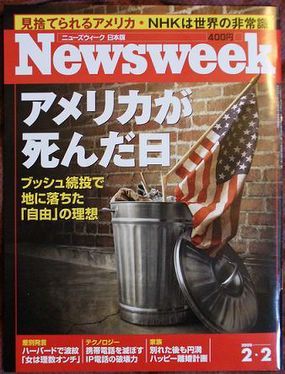 A blogger with an interest in learning Japanese stumbled across that nation’s version of Newsweek.
Pictures being worth thousands of words and all, this cover does demand your attention, with the American flag in the trash can.
But before you rush to judgement about what Newsweek was thinking, you really ought to look at the translation of the cover text.
In case you can’t make out the text, click on the cover to the left to open it in a new window.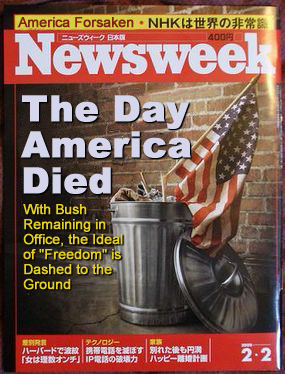 Rick Adams translated the page, and it certainly is an eye-opener:
“The Day America Died”
“With Bush Remaining in Office, the Ideal of “Freedom” is Dashed to the Ground”
The supporting text inside isn’t much friendlier:
From the editorial staff“Since Newsweek is an American magazine, why would it tell us of problems with Bush?” we are occasionally asked in an ironic tone. However, we do not take sides, but only analyze the meaning of events from various viewpoints. Perhaps this has led to misunderstandings.
What have Americans lost due to the Bush administration in the last four years, and what will the world lose in the next four years? Verified facts, not opinions from any viewpoint, are laid forth in the special report in this issue.
You think Newsweek will get complaints about this? How many Americans will interpret this as pandering to anti-American audiences, or even worse, a possible cause of anti-American global sentiment. And why would Newsweek carry these “verified facts, free from opinion” in international editions instead of say, I don’t know, publishing them in the United States?
Step carefully, Newsweek.
Update to a previous post:
Looks like the Boy Scouts are having problems in places other than Birmingham. Now, the Feds are investigating allegations that the Atlanta area Scouting operation may have artificially inflated its minority membership. For the time being, the United Way in Atlanta has withheld its allocation to the Boy Scouts while the charges are pending. (United Way contributions that were designated directly for the Boy Scouts are being passed along.)
Hint: Scouting supervisors across the United States better start brushing up on that crisis communications plan…
The spinning is slow in Bentonville
It appears as though Wal-Mart’s 180-degree shift on speaking to the media will pay off — but that hasn’t yet popped up on the bottom line.
Despite strong retail numbers, Wal-Mart missed Wall Street projections recently.
“Management distractions can have a tremendous effect on a company,” said Craig Johnson, retail analyst with Customer Growth Partners. “The good news is that Wal-Mart took some action and they’re putting more effort into their public relations.”
But that’s not likely to be enough to help pull the world’s largest retailer out of its funk.
“Wal-Mart has to redefine itself to consumers,” said Johnson. “If the lowest price pitch is its only value proposition, that’s yesterday’s news.” In other words, it needs to come up with something new and fresh instead of just rocking along like it’s the 1980s.
By contrast, Target exceeded expectations.
Even though the CNN reporter touched on a good bit of Wal-Mart’s problem, there’s another theory floating that gets greater play. The notion is that Wal-Mart does better in a bad economy, because shoppers are more interested in value. (Rather ironic for those politicos and experts who tout this as “the worst economy ever.”)
We’ll see if the economists change their tune in a year or so, when we can quantify coverage as good hits and bad hits, and compare it to the stock performace. (Which has been for the most part flat since long before Wal-Mart’s first news conference in Bentonville.)
You are currently browsing the Accentuate the Positive, 3.0 weblog archives for the 'Uncategorized' category.


| S | M | T | W | T | F | S |
|---|---|---|---|---|---|---|
| « Jul | ||||||
| 1 | ||||||
| 2 | 3 | 4 | 5 | 6 | 7 | 8 |
| 9 | 10 | 11 | 12 | 13 | 14 | 15 |
| 16 | 17 | 18 | 19 | 20 | 21 | 22 |
| 23 | 24 | 25 | 26 | 27 | 28 | |